
Logic Lessons: Six Common Logical Fallacies
Lesson 2

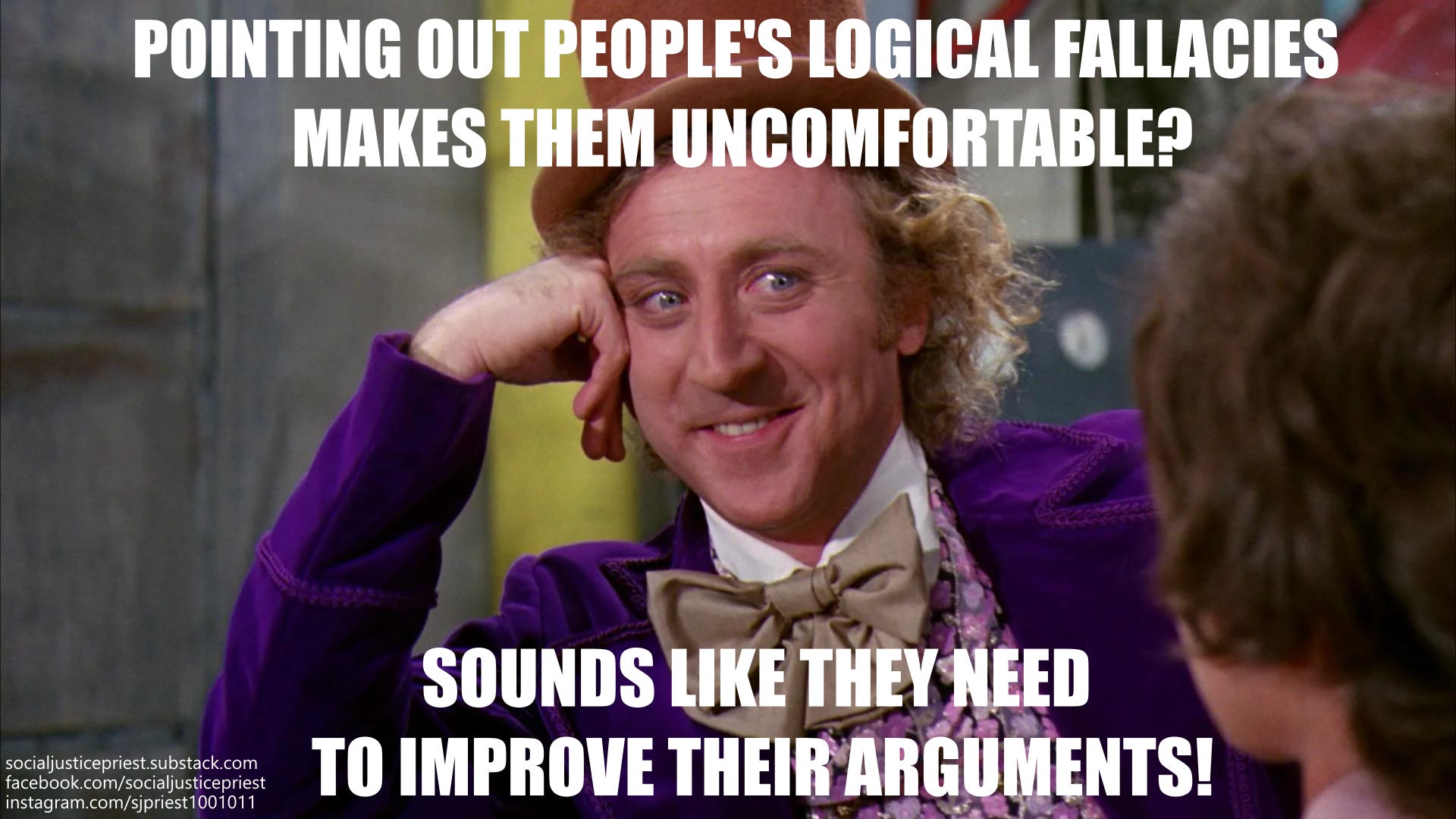
Our ability to think far surpasses those of any other creature. Starting with the control of fire, it has allowed us to invent tools to overcome most of our natural disadvantages. We built machines to make up for our lack of strength and invented medicines to extend our lives, to name a couple of examples. Doing this required pattern recognition, data analysis, judgement, and the ability to share this information with others. That said, our skills aren’t perfect.
When we are in a crisis or reacting to events around us, our brains often use shortcuts to make decisions quickly. While this was/is necessary to ensure our survival, it can often cause us to make mistakes. This is especially true if we use the same shortcuts when trying to make rational decisions or persuade others. These mistakes are known as logical fallacies.
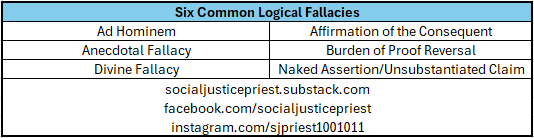
What are logical fallacies? According to Purdue University, logical fallacies “are common errors in reasoning that will undermine the logic of your argument” [1]. In other words, arguments containing logical fallacies are usually invalid and therefore not worth any further consideration. While they are often committed accidentally, some people intentionally use logical fallacies to deceive, persuade, or scam others. Advertisements are notorious for using logical fallacies like appealing to popularity (discussed below) to get people to buy their products. Blatantly lying to people in advertisements is illegal, but using bad arguments is not. This is just one of many reasons why it’s important to be able to understand and recognize logical fallacies. There are dozens of logical fallacies out there, but here are six of the most common ones:
Ad Hominem
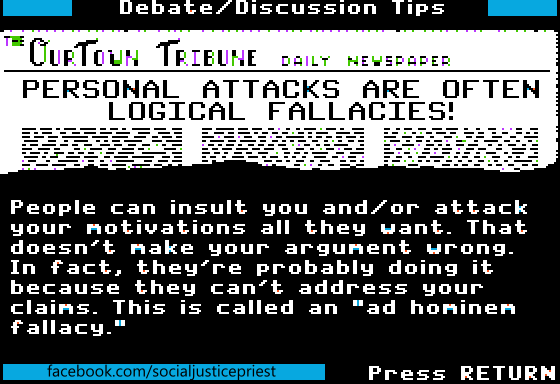
Attacking the person instead of the argument and then claiming the person’s argument is invalid because of it. I encountered this fallacy quite often back in my hardcore atheist/anti-theist days (for the record, I am now an agnostic Unitarian Universalist). Conservative Christians would often claim my arguments against their religion were invalid because I was a “christophobe” or a “God-hater.” Whether or not that was true (for the record, it wasn’t) that by itself didn’t mean the arguments I made were invalid. Another version of this is attacking a person’s motivations instead of their argument. Someone’s motivation for making an argument doesn’t mean that argument is invalid.
Affirmation of the Consequent
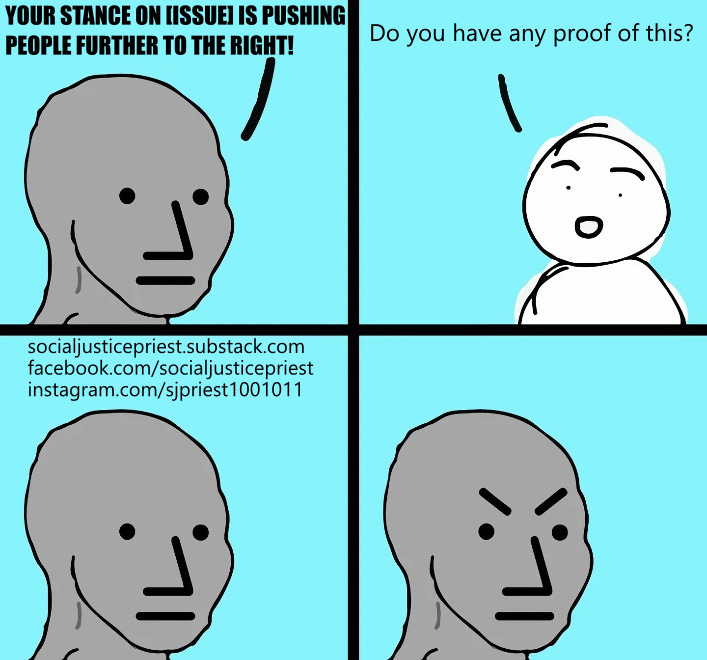
In my deductive reasoning article, I explained principles (p) and consequences (q). If “p” implies “q,” then the presence of “p” means “q” is also present. The affirmation of the consequent fallacy is when someone argues that the presence of “q” means “p” is also present. This is commonly used as justification for tone-policing/concern trolling. A Black person says, “Black Lives Matter” and the concern troll responds with, “This is why Trump won!” (Another common version of concern-trolling argument is the one in the image above.) While Trump did win in 2024 (q), there’s no evidence it was because people were saying “Black Lives Matter” (p). In fact, it could very well be true Trump won because people didn’t say “Black Lives Matter” enough!
Anecdotal Fallacy
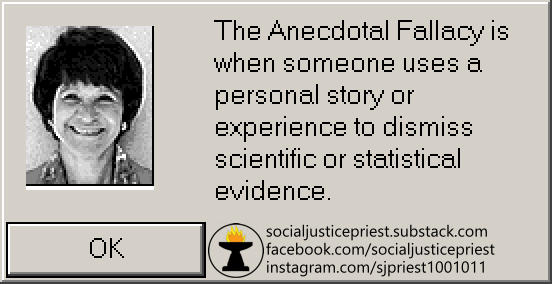
I’m sure we’ve all seen this fallacy at least once. Person A shares scientific evidence supporting point XYZ and Person B responds by saying their personal experience refutes Person A’s evidence. This is fallacy because one incident doesn’t negate statistical significance. Another reason is there’s no way to verify the accuracy of Person B’s statement. I’m not calling them a liar (though they could be), I’m saying they could be confusing correlation with causation or misremembering the details. That said, there are times when anecdotes are fine to use. If someone claims your lived experiences are wrong because it contradicts their unsubstantiated opinions, no one will fault you for trusting your experiences over the other person’s opinions.
Burden of Proof Reversal
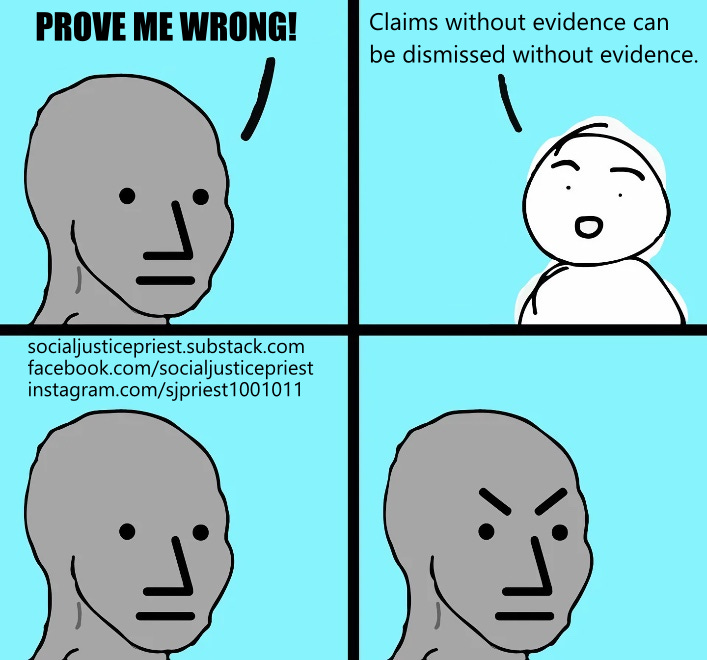
“Prove me wrong!” “Change my mind!” “You can’t prove that I don’t!” All of these are examples of burden of proof reversal. Someone makes a strong positive or negative claim and then demands you prove them wrong. This is a fallacy because the burden of proof is on the person making the claim. If they can’t provide evidence to support their claims, you have no obligation to provide evidence refuting them.
Divine Fallacy

“It’s true because I said so/want it be so!” Some alternate versions of this are people claiming statements are “self-evident,” “common sense,” or “reality.” Claiming something doesn’t need evidence doesn’t make it so. You can dismantle this fallacy by simply asking, “What makes it self-evident?” If you’re feeling feisty, another way to dismantle this argument is to make the opposite claim, state it’s also self-evident, and then ask them why their claim is more valid than yours. You’d think it would be obvious to most adults that saying something is true doesn’t make it so, but here we are.
Naked Assertion/Unsubstantiated Claim
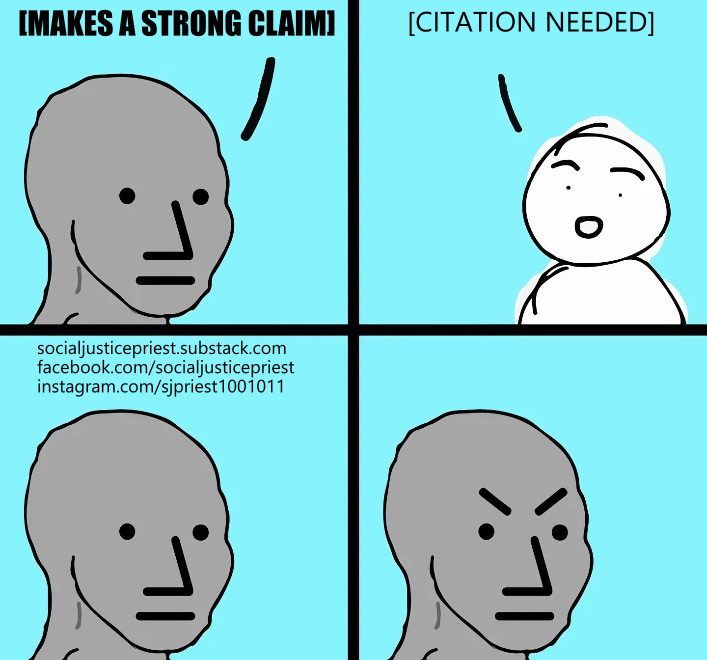
This is when someone makes a claim without proof. The easy answer to this is to ask them for a source, proof, or evidence of their claim. If they refuse, you can tell them, “Claims without evidence can be dismissed without evidence.” The one caveat to this is some claims are very difficult, if not impossible, to prove. For example, certain personal experiences. A person may claim a helmet saved their life as a kid because they ran into something and the collision sheared off a piece of their helmet instead of their head. Unless they still have that helmet, there’s no way to “prove” that story is true. People will either believe them or they won’t. While this is technically still a naked assertion, the reason behind why the person is telling the story likely makes it a better fit for a different logical fallacy. (For the record, I strongly believe helmets save lives.)
BONUS: The Fallacy Fallacy
This is a controversial one. The fallacy fallacy is when someone claims a person’s conclusion is wrong because the argument they made to support it contains a logical fallacy. The reason this fallacy is controversial is because many people misunderstand what logical fallacies are. While it’s true arguments containing logical fallacies are invalid, that doesn’t mean the conclusion of said arguments are wrong. It means the arguments don’t support the conclusion and better arguments are needed. Otherwise, it’s an unsubstantiated claim.
These are only six (Plus a bonus one!) of the most common fallacies. There are dozens of logical fallacies out there. I plan to cover more of the common ones in a later article.
Finally, some people will get upset with you for pointing out the logical fallacies in their statements. Let them. Their anger doesn’t make you wrong. In fact, that’s another logical fallacy: appeal to emotion.
Sources:
[1] https://owl.purdue.edu/owl/general_writing/academic_writing/logic_in_argumentative_writing/fallacies.html
The rest comes from the knowledge I acquired through the logic classes I took for my engineering degree, the ethics classes I took for my MBA, and decades of talking politics.
Enjoying my content?